For years I treated my inability to focus as a character flaw. I read the willpower books, made the promises, and by mid-morning I had lost again to a phone I had sworn to ignore. What finally changed things was embarrassingly simple: I stopped trying to win the fight and started removing the fight from the room. Distraction is not a moral failure. It is a design problem, and design problems have design solutions.
Willpower is real, but it is expensive and unreliable. It runs low exactly when you need it most — late in the day, when you are tired, hungry, stressed, or bored. If your plan to stay focused depends on being the best version of yourself for eight straight hours, you have built a plan that only works on your best days.
The deeper problem is that willpower is a reactive tool. It only activates after the temptation appears. By the time you are consciously resisting the urge to check your phone, you have already noticed the phone, felt the pull, and spent attention deciding not to act. You might win that particular round, but you fought it at all — and you will fight it again in ninety seconds. Multiply that across a day and you understand why focused work feels exhausting even when you technically "behaved."
Environment design flips the order. Instead of resisting temptations one by one, you arrange your surroundings so most temptations never reach your awareness. The goal is not to be stronger. The goal is to need less strength.
The core principle: friction is a dial you control#
Every action you take has a cost in effort, and you are exquisitely sensitive to it. We reliably drift toward whatever is easiest and away from whatever is even slightly harder. This is not laziness; it is how attention conserves energy. The trick is to stop fighting that tendency and start using it.
The whole strategy reduces to one sentence:
Add friction to distractions. Remove friction from focus.
- Make the distracting thing take one extra step: another room, another login, another tap.
- Make the focused thing take one fewer step: already open, already loaded, already the default.
You do not need much. In my experience, a single added step — walking to the kitchen to get my phone rather than reaching into my pocket — is enough to break the automatic loop. The urge to check arrives, but the payoff is now twenty seconds away instead of zero, and most of the time the urge simply dissolves before I stand up.
A quick trade-off worth naming#
More friction is not always better. If you bury your focus tools too deep or lock your phone in a safe with a timer, you will eventually resent the setup and abandon it, or you will route around it in ways that cost you more. The aim is the smallest barrier that reliably interrupts the automatic reach. Start gentle and add friction only where you keep losing.
Redesign the physical space#
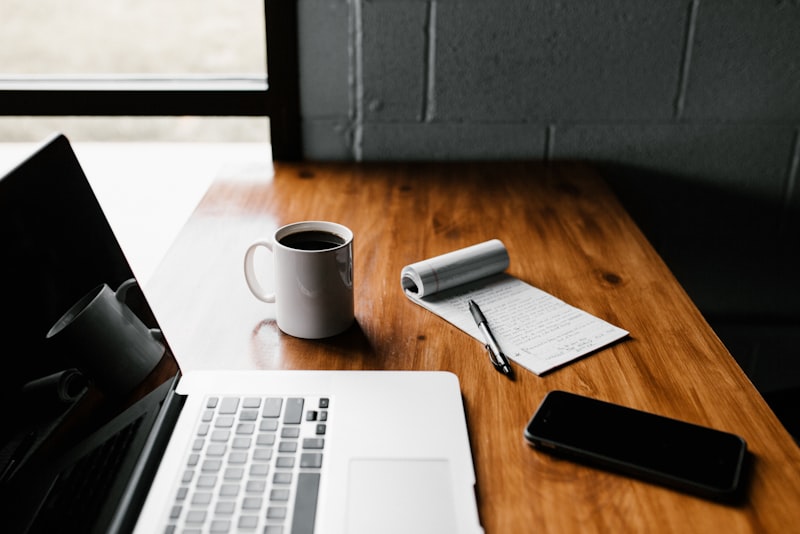
Your desk is the first environment to fix, because it is where the automatic behaviors live.
- Move the phone out of arm's reach. Not face-down on the desk — genuinely across the room, or in a drawer in another room. Out of sight is good; out of reach is what actually matters.
- Clear the visual field. Anything on your desk is a potential thought. A stack of unrelated mail, a book you meant to read, a second screen playing something — each one is an open loop quietly competing for attention. Give the surface as little to say as possible.
- Give focus a physical home. If deep work happens at a specific desk, in a specific chair, with a specific lamp on, your brain starts to treat that arrangement as a cue. I keep one corner that is only for writing. Sitting there means one thing, and my mind has learned it.
The counterintuitive part: leisure needs a designated space too. When I let the couch double as an occasional workspace, work started leaking into rest and rest started leaking into work, and both got worse. Keeping them physically separate protects focus and recovery.
Redesign the devices#
Physical space is the easy half. The harder half is the glowing rectangle you carry everywhere, because it collapses the distance between "I have a stray thought" and "I am now watching a stranger reorganize their pantry."
Separate work from leisure at the device level#
The single most effective change I have made is refusing to let one device do everything.
- Two devices, if you can. A cheap, boring second phone or an old tablet with none of your entertainment apps becomes your "work phone." The distracting apps simply do not exist on it. There is nothing to resist because there is nothing there.
- Two profiles, if you can't. Most laptops and phones now support separate user profiles or a dedicated "work" mode. A work profile with only work apps, and a personal profile with everything else, gives you most of the benefit of two devices for free. Switching profiles is a deliberate act — exactly the friction you want between contexts.
- Two browsers. At minimum, use one browser (or browser profile) exclusively for work and a different one for personal browsing. No shared logins, no autofilled social media, no bookmarks bar full of rabbit holes. When your work browser opens to a blank, boring start page, there is nowhere to wander.
The point of all this separation is not organization. It is that the leisure environment is never one tap away from the work environment. You have to cross a border, and borders make you notice what you are doing.
Make airplane mode the default, not the exception#
Do not rely on remembering to silence notifications. Build it into the ritual.
- Start every focus block by switching the phone to airplane mode — or full Do Not Disturb — before you begin, not after the first interruption.
- Treat connectivity as something you turn on deliberately when a task genuinely requires it, rather than something that is always on and occasionally suppressed.
- If your work needs the internet but not messages, disconnect the specific channels: quit the chat app, close the email tab. An open Slack is a doorway; a closed one is a wall.
The reframe that made this stick for me: being reachable is a choice I make, not a state I exist in. Airplane mode is not deprivation. It is a fixed appointment with my own attention, and the messages are all still there when it ends.
Fix the first thing you see#
Your default screen is the most valuable real estate you own, because you look at it dozens of times a day without deciding to.
- Move every tempting app off the home screen and out of the dock. If you have to search for an app by typing its name, you have added just enough friction to interrupt the reflex — and you will often realize, mid-type, that you did not actually want it.
- Make your home screen and desktop deliberately dull. No red badges, no feeds, no shortcuts to entertainment. A plain wallpaper and a clock is fine. Boring is the feature.
- If you can, set your work device to open directly into the task — the document, the code editor, the notebook — so the first thing you see is the work, not a launchpad of options.
When the first thing you see supports focus, you get pulled into the task by the same automatic drift that used to pull you away from it.
When the environment can't be controlled#
Sometimes you are in a shared office, a noisy cafe, or stuck on one locked-down laptop, and you cannot redesign much. A few portable tactics help:
- Carry your own boundary. Noise-cancelling headphones or even simple earplugs create a private environment inside a shared one. The signal to others ("I am unavailable") is a bonus.
- Use physical placeholders. A sticky note over a distracting corner of the screen, or a notebook where you park stray thoughts to deal with later, keeps interruptions from becoming detours.
- Batch the unavoidable. If notifications must stay on for a role, cluster the checking into set moments rather than reacting continuously. You are recreating friction with time instead of space.
None of these are as strong as a fully redesigned setup, but they prove the principle travels: even a little engineered distance restores a lot of attention.
Start with one change#
You do not need to overhaul everything this week. Environment design compounds, so pick the single distraction that costs you the most and put one step of distance between it and your reflex. For most people that is the phone, and the change is as small as choosing a spot across the room.
Give it a few days and notice how much quieter your attention gets when you are no longer negotiating with temptation all day long. That quiet is not discipline. It is a room arranged so you rarely have to be disciplined at all — which, it turns out, is the only version of focus I have ever been able to keep.